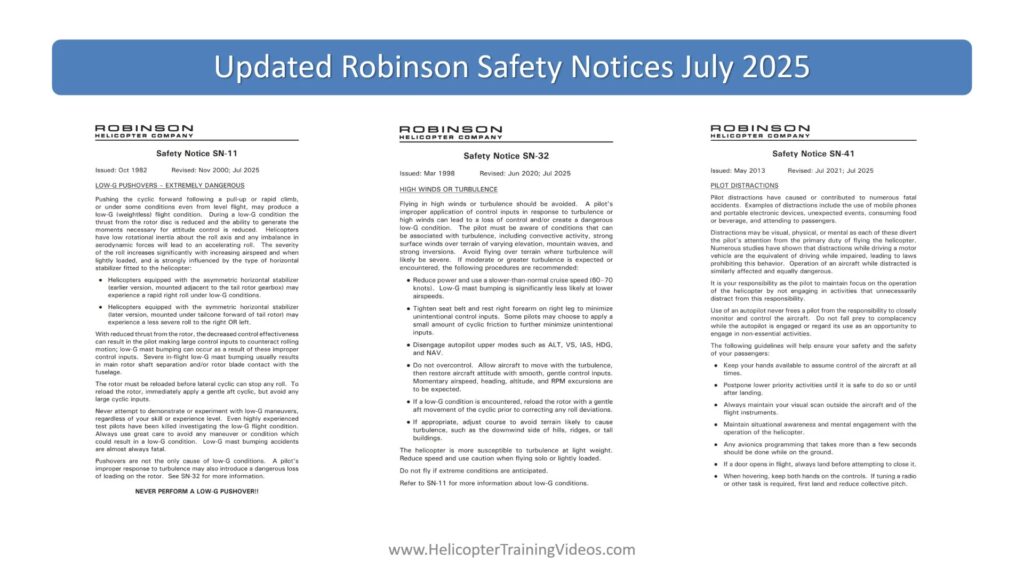
Robinson Helicopters has just released (July 2025) important updates to three Safety Notices (SN-11, SN-32, and SN-41) that every R22, R44, and R66 pilot should review. These updates are based on accident data, advances in technology, and a deeper understanding of flight dynamics – with the goal of improving safety through education and awareness.
You can also watch a video breakdown of the changes below:
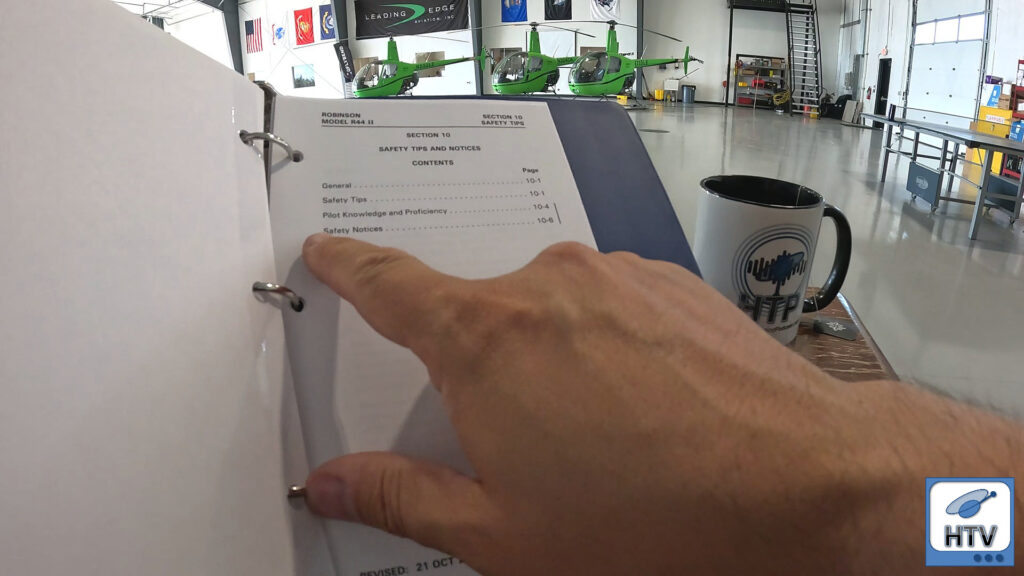
If you fly a Robinson helicopter, you’ll find these notices in Section 10 of your Pilot Operating Handbook (POH), under “Safety Tips and Notices.” I always recommend that students, and pilots new to Robinson aircraft, read these periodically throughout their training and beyond as the guidance takes on new and deeper meaning as your experience grows.
Why the Updates Matter
Robinson doesn’t revise Safety Notices on a set schedule. Updates happen when there’s a change in technology, a new hazard is identified, or accident data reveals lessons that can make us safer pilots. I believe the tragic R66 accident in Australia in October 2023 is one such accident. The Australian Transport Safety Bureau (ATSB) investigation report and video included striking 3D reconstructions combined with actual cockpit footage, highlighting how a combination of turbulence, low-G conditions, overreliance on autopilot and distraction can all lead to a fatal loss of control. We will reference that accident in this article, but I highly recommend you read the full ATSB report and watch the full ATSB video.
SN-11: Low-G Pushovers – Extremely Dangerous
Previously updated: 2000
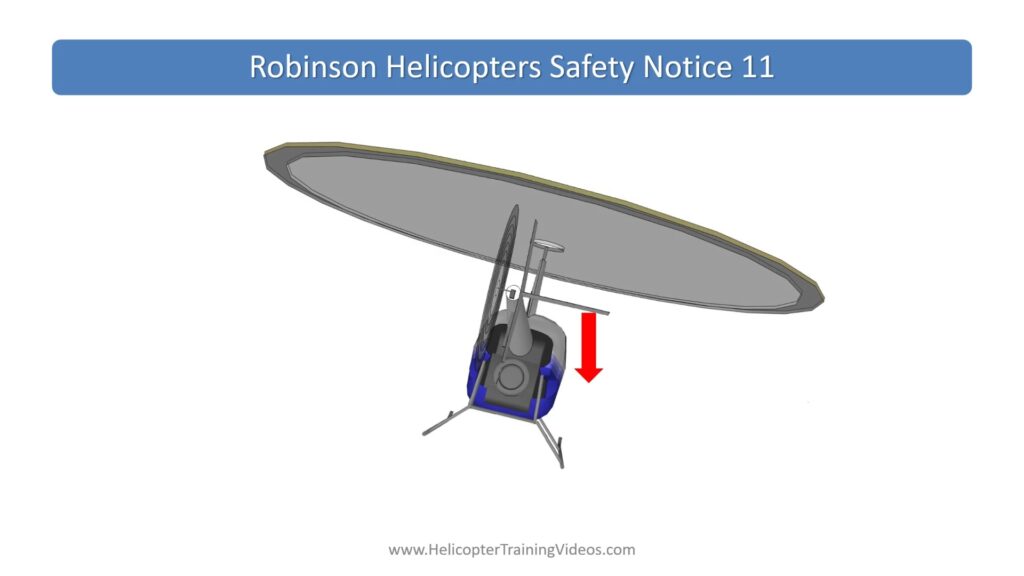
- New explanation of roll dynamics based on computer modeling.
- New stabilizer means less severe roll, but could be right or left.
- Recovery now reads “stop any roll” and “avoid any large cyclic inputs,” applying gentle aft cyclic first to reload the rotor.
In older Robinson helicopters, the horizontal stabilizer was mounted on the right side only, and computer modelling showed it significantly increased right-roll tendency during low-G. The new symmetrical stabilizer reduces roll rate, but the roll could now be either right or left.
The updated notice also talks about the increased risk to low-G when flying faster, especially when lightly loaded. Here are some reasons why that is an issue:
- The faster you go, the more aerodynamic downforce is generated on the asymmetric stabilizer, which increases the rolling moment and the rate of deviation.
- Lighter weight means less inertia to resist changes in attitude, so the helicopter will accelerate more quickly into any roll or pitch deviation.
- The faster you go, the more effective the cyclic becomes. One inch of left cyclic at 30 knots will have much less effect on the rotor disc than the same input at 90 knots. Increased relative wind and more horizontal airflow create more aerodynamic force on the blades for the same change in blade pitch, which can lead to overcontrolling and mast bumping. This is part of the reason we slow to 60–70 knots in turbulence (more on that later).
- Although the asymmetrical horizontal stabilizer was shown to be the main cause of rapid right roll, the tail rotor thrust acting above the center of gravity in the nose-low, tail-high attitude typical of high-speed flight may still add to the problem.
The updated notice also mentions how turbulence can also trigger low-G, not just pushovers and references SN-32 for more information.
SN-32: High Winds or Turbulence
Previously updated: 2020
- Specific turbulence conditions now listed:
- Convective activity
- Strong surface winds over varied terrain
- Mountain waves
- Strong inversions
- New trigger to use turbulence flight procedures – when moderate or greater turbulence is encountered or expected (instead of the old “significant turbulence” definition).
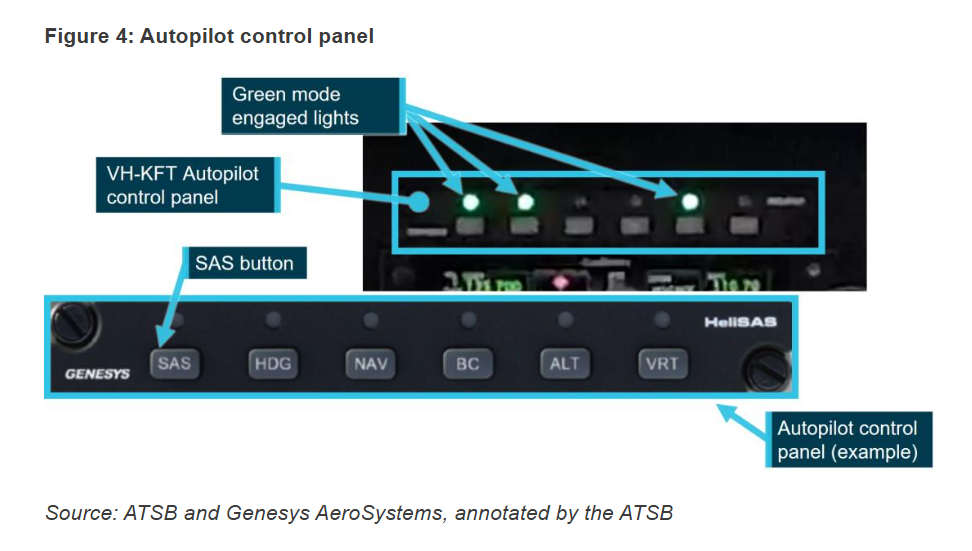
- Autopilot procedures added: disengage “upper modes” such as ALT, VS, IAS, HDG, and NAV.
Moderate turbulence is turbulence that causes: (1) changes in altitude or attitude; (2) variations in indicated airspeed; and (3) aircraft occupants to feel definite strains against seat belts.
Robinson R22 POH Limitations 2-15
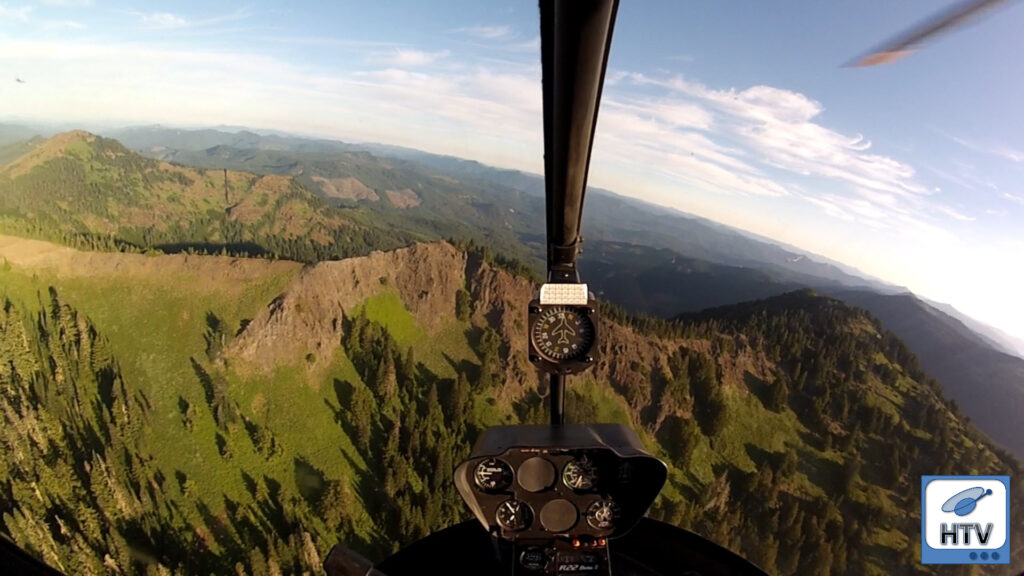
The R66 accident illustrates how encountering turbulence from strong winds over steep terrain can escalate quickly. This notice now encourages avoiding terrain where turbulence could be severe, slowing to 60–70 knots, along with previous guidance of bracing forearm on leg, tighten seat belt and consider adding a small amount of cyclic friction.
SN-41: Pilot Distractions
Previously updated: 2021
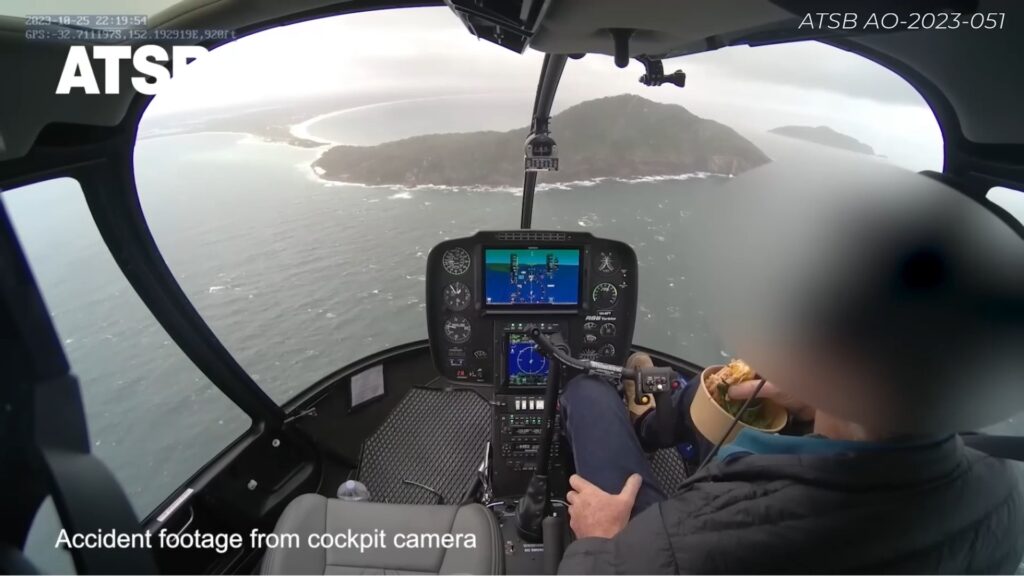
- Adds eating, drinking, and “unexpected events” (bird strikes, loose objects) to distraction examples.
- Reinforces the dangers of autopilot complacency.
- Compares distracted flying to impaired driving.
In the October 2023 R66 accident, the pilot was eating with both hands off the controls while autopilot was engaged. When turbulence hit, he tried to fly with his left hand only, was unable to slow down or recover, and the aircraft rolled inverted with fatal consequences.
Final Thoughts
Robinson’s updates reflect a commitment to safety, both through hardware changes and clear, practical pilot guidance. As pilots, we should match that commitment by keeping our POHs current and revisiting Safety Notices and other sections of the POH regularly.
You can subscribe to Robinson updates or download the latest POHs for free. And next time you open your POH, don’t just skip to the performance charts, spend a few minutes on the Safety Notices, because in aviation we all know, Knowledge IS Safety!